The True Story of the Paretti Club

It’s not easy being weird but I’ve spent the course of some five years researching and drafting what has so far resulted in an 8,000 word essay I wound up calling Revolt Club, Long Island City: Uncovering a Lost History of Queens Political Clubs. I started out by wanting to make the slightest point.

The Paretti Club headquarters, Long Island Daily Star, 1934

Around 2019/2020, I set out to correct rumors around a building at 38-62 11th Street, a three story, brick Colonial on an industrial street. If you’ve ever lived in or around Queensbridge, the Ravenswood Houses or in the mixed-use area in between (or just wandered around north of the Queensborough Bridge), there’s likely a decent chance you’ve noticed a vertical EXILE marquee attached to an imposing, stately facade with 13 front windows (plus a transom window and five front basement windows), wide, black doors and various ornamentation. Less obvious would be the two-story ballroom inside on the second floor with a surrounding balcony, the site of all-night Depression era dances and 1980 punk shows that included the Misfits. The site is not an official landmark but it’s arguably among the most intriguing and exquisite prewar gems in the Long Island City-Astoria area, up there with the Long Island City Courthouse, MoMA PS1, the Terra Cotta Works building, the Sohmer Piano Factory, the Loew’s Triboro Theater, the Masonic Temple and the Moose Lodge, and it tells a story about the neighborhood and about modern Queens.
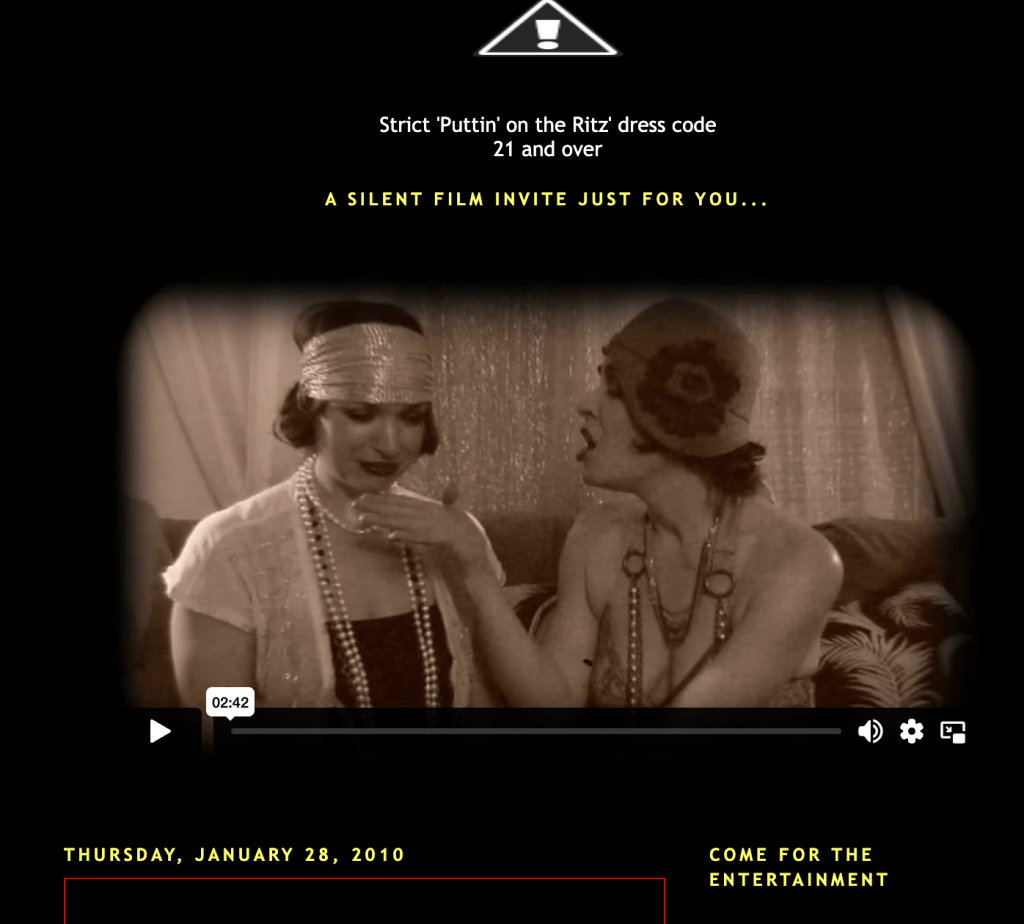
Screenshot from promotional blogpost for 2010 party, Beautiful and Damned

When I moved to 36th Avenue in 2015, I was curious about the building, with the inscription James J. Paretti Association, Inc., across the top and 1933 at the bottom corner. I figured the building once housed some kind organization that served an Italian community that once existed more prominently in Long Island City, but I had no idea what sort of organization, and how it possibly served the community. It wasn’t like I could find a Wikipedia page about James J. Paretti, or any kind of reliable article anywhere on the immediate surface of the Internet. One blog post, an advertisement for an event called Beautiful and Damned, made claims about the building, ostensibly to lure a Brooklyn and Manhattan crowd to the first Queens stop on the F train, and into a desolate, industrial area at night for a 1920s-themed party. The promotional content claimed that Tammany (the former name for Manhattan’s Democratic Party organization) built the Paretti building as a headquarters. (Sure, the building looked like Tammany Hall itself at Union Square but smaller). The playful advertisement also claimed the building became a speakeasy, and only later became a “Democratic party headquarters” before one day transforming into a punk rock club. For a while, this was the only thing you could find online about Paretti Hall, unless you used newspapers.com or the New York Times “Time Machine” tool or some other site (likely by a paid subscription or a library account) that let you explore archived newspapers–but even that would be limited to a handful of articles referencing James Paretti or the clubhouse.
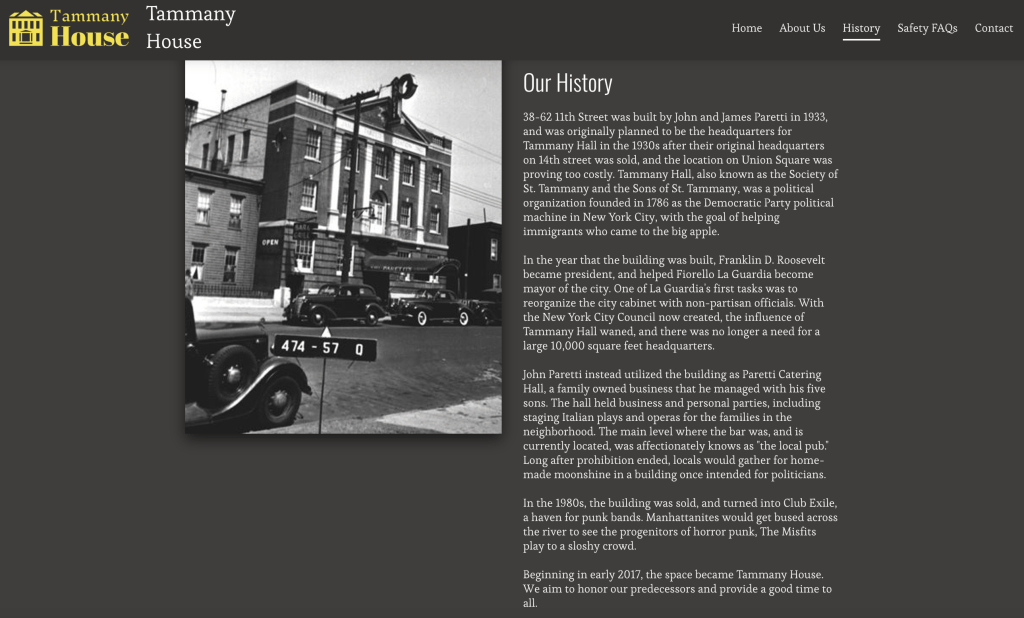
The Tammany House website, using a 1940 tax department photo and a false narrative.
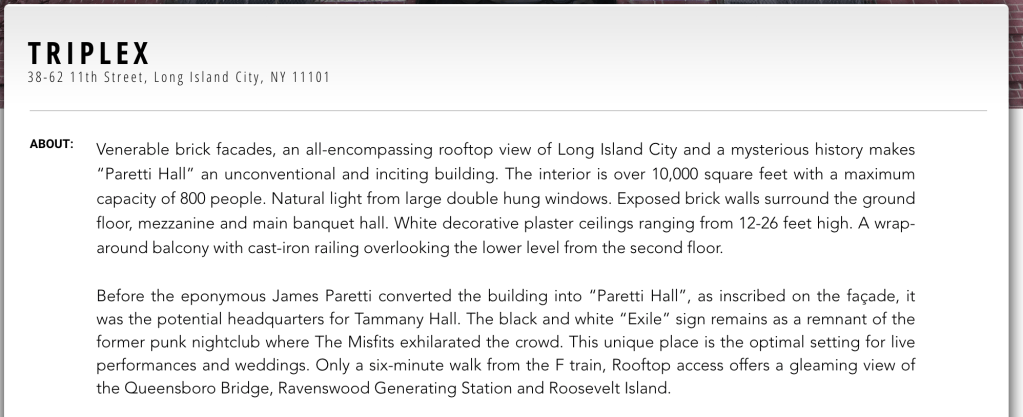
Motif Studios also uses the Tammany rumor on its website for the Triplex.

I read the Beautiful and Damned advertisement/flyer website, probably in 2015 (and watched its silent-film styled video), and over the years, when I thought of writing my own, journalistic blog post, I Googled the site again, and found that in 2017, a company called Warehouse LLC, which purchased the site in 2014, began to market the building as an event space called Tammany House. Tammany House posted pictures of one or more events, a photo shoot, a concert, that happened in the then-renovated interior. Another company, Motif Studios, also rented the space as Triplex LIC. Both companies’ websites echoed the rumor that Tammany built Paretti Hall!

Tammany House invented its own elaboration on the so-called history, claiming that John and James Paretti built the site in 1933 but that it was “originally planned to be the headquarters for Tammany Hall after their original headquarters on 14th Street was sold.” The Tammany House website went on to say that in the year the building was built (1933), Franklin D. Roosevelt became president (that’s true) and “helped” Fiorello LaGuardia become mayor. Well, I don’t know to what end that might be true (FDR was a Democrat, LaGuardia was a Republican who ran on a Fusion ticket) but anyway LaGuardia did win an election in 1933, and became mayor in 1934. The Tammany House website says LaGuardia reformed City Hall (which is true), and then, “With the New York City Council now created,”(the City Council did not go into effect until 1938) “the influence of Tammany Hall waned” (that’s true) and there was no more need for a “10,000 square feet” Tammany headquarters in Queens. The website then concluded that James Paretti decided to use the building as a catering hall.

In 2017 a local Long Island City blog called LIC Talk helped promote Tammany House with a blog post called The Legend of Paretti Hall. The author made the lazy remark: “Who exactly was James J. Paretti and what was his ‘Association’ are lost to the sands of time. In fact the building’s precise history is not fully verifiable. ”

You might say that I took that as a personal challenge. I thought to myself: there has to be a way to answer those questions! First, I lucked out, because in 2018 two of James Paretti’s descendants posted comments on LIC Talk‘s post, and one left an email address. That got me talking to the family (by sometime in 2019 or so), which was amazing, and I was grateful. They connected me to some other people from the neighborhood. Then, around summer 2020, I started digging into Census records and digital newspaper archives. Later, starting in 2021, I spent most of my weekends for a few years in the archives of the Queens Public Library’s Central branch in Jamaica, reading primarily the Long Island Daily Star, which had never been digitized but had a lot of details on James Paretti. First I read all of 1935, when James Paretti ran for alderman, then I focused mainly on election seasons from roughly 1925 to 1938. When not in the library I simply educated myself on New York City history, and let me tell you Queens history from 1898 to 1945 as far as I can tell barely exists in the form of any books or serious literature.

Here are three points why the Tammany House claims are false and you might even say problematic.

  1. Tammany Hall was a Manhattan organization. There was no possibility of it ever setting up a headquarters in Queens. Queens had its own Democratic party organization. Sure, Tammany’s Al Smith was governor of the whole state in the 1920s, but the organization itself represented one manifestation of the New York County Democratic Committee, and it would not in all likelihood relocate its headquarters to some other county. That would in essence be absurd. In fact the early Queens Democratic County Committee was not an ally of Tammany. And in the 1930s when James Sheridan, a New Dealer, took over the Queens Democratic Party, it was if anything more related to the Bronx Democratic Party than Tammany.
  2. James J. Paretti had essentially nothing to do with Tammany Hall. The closest link I can make is that in 1929 he ran for state assembly with the Clean Government Party (by then calling itself the Queens Democracy), which was led by Frank X. Sullivan, who lived in Queens but had run a Tammany campaign for Jimmy Walker in Queens in 1925. (There were for a few years or so “Queens Tammany” clubs in the Sullivan faction.) The building resembles Tammany Hall, but likely just as a figurative Italian version of a Tammany Hall for the Long Island City area. Labeling the building “Tammany House” in a roundabout way erases the actual history of Italians in politics in Long Island City and Astoria during the turbulent 1930s. Besides running a club that served as a resource for the community (call it “machine politics”, if you will), Paretti served in the Board of Alderman for two years–an incredible two years that involved major New Deal works projects in his district, which spanned LIC and Astoria. Not only that, but in 1935 he defeated an incumbent, Carl Deutschmann, for alderman, becoming, with Mario Cariello, I believe one of the first two Italian-Americans to represent the area in government. We might take for granted now that Italians are normally in office in New York, but these were first-generation children of immigrants, when the community was still relatively new to the country and considered poor and outside of the system, Fiorello LaGuardia notwithstanding. Imagine if in 90 years someone came across the names Julie Won, Linda Lee, Shekar Krishnan, Steven Raga or Jenifer Rajkumar and said they ran a catering hall, or something? And what if there were a landmark, or some type of time capsule, for any one of them, and someone gave it a made-up, irrelevant history?
  3. The Paretti building was, indeed, used as a catering hall, but that was secondary to its purpose as a political club. You can say the underlying purpose of the club was to elevate the Italian community into power in Queens’ First Assembly District, and to supplant the powerful Regular Democratic Club of the First A.D., which became associated with the corruption of the boss John Theofel in the early 1930s. Tammany House likely got its details about the place staging Italian operas from a self-published memoir called Rita, but the author, Mary Restivo, was recalling her early childhood, and wouldn’t necessarily remember the political story of James Paretti. The Paretti Club had other locations, including the family residence next-door, before building the large, extravagant clubhouse, which you might say was a statement. There were at the time hundreds of political clubs in Queens, some which met in stand-alone clubhouses, others in storefronts or residences. These clubs also hosted rallies and dances in the old social halls, such as the Moose Lodge or the ballroom which is now Break Bar. In the high point of political clubs, Queens was believed to have more political clubs and civic associations than the other four boroughs, despite being second-to-last in population. That said, the Paretti building is actually a testament to the cultural history of Queens in the first half of 20th Century.

I’m not saying that I ever considered my investigation finished. It isn’t, but eventually I felt ready to publish a sort of origin story that I was able to piece together. It’s the story of a revolt club. Maybe you’ll want to set aside some time to read it, and I’d be grateful. Or just wait for me to write the more detailed story.

Some new things in the Queensbridge-Ravenswood area

It has been one and a half years since the last post on this blog. And for some reason, according to stats, people still visit this blog. Now would be a good time to make note of some new and potentially new things in the Queensbridge-Ravenswood area.

Vordonia

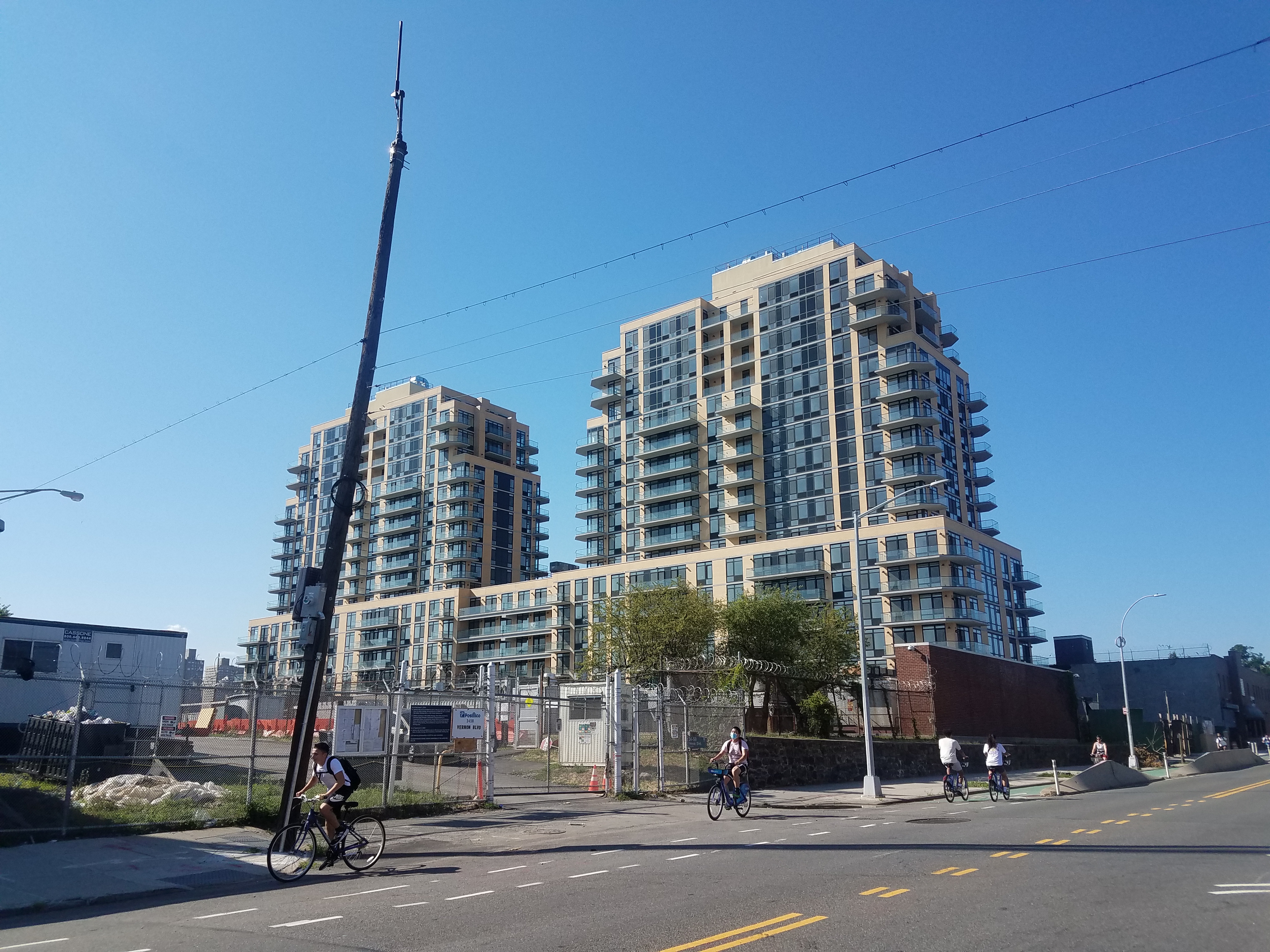
Quietly, Alma Realty’s 404 unit, double-tower building between the waterfront and Vernon Boulevard, has apparently opened and now has residents moving in. The site, formerly called Alma Towers, is now called the Vordonia Towers, ostensibly after a small Greek village, with a logo reminiscent of “Pointy Haired Boss” from the Dilbert cartoons. The Vordonia Towers took about seven years to complete since construction began in fall 2014, or more than twice the average time it takes to build a residential building in New York City. Astoria-based Alma bought the property in 2001, so we’re talking about a 20 year epic here.

So, what will it mean for the Ravenswood area? We can say that more than 400 residents will be added to our little, gritty, quiet corner of LIC/Astoria. Current listed rents range from $2,676 to $3,025 for one bedroom apartments. That’s average for Astoria, according to RentHop, but probably higher than average and the median for this corner of it, even among private rental buildings alone.

For sure, there will be population growth. The influx from Vordonia alone, might mean more people on the Q103/102, walking down 36th, 35th and Vernon avenues to the subways, getting coffee at Flor de Azalea or Château le Woof, using the Citibikes, going to Rainey and Socrates parks, etc. They won’t use the 9th Street Laundromat because they’ll have washers and driers, according to these cheesy promotional videos by real estate company, Compass’s “Irizarry Team.” One video is especially…. let’s say, avant-garde?: a woman looks out her window, drinks from a mug on her balcony, rides a stair master in slow-mo (as we see from below and behind), meditates, and in an epic sequence, struts up Vernon Boulevard in a black jacket and shades, returns to her apartment where candles are already lit, removes her bag and her coat revealing her crop top situation, then sits carefully down to look out the window again. Her window apparently does not face Big Allis.

The videos attempt to sell the towers by selling Astoria: its parks (Astoria Park, not Rainey or Socrates for some reason), shopping (aerial of Costco’s parking lot) and diverse cuisine. But the Vordonia Towers are barely in Astoria. I say this directly to the new and prospective Vordonia tenants: This area is sort of Astoria, or “South Astoria.” There is a distinct difference in ambience and geography from Astoria proper. In fact, I should change the name of this blog to “Not Astoria.” This neighborhood, from south of the Queensborough Bridge to Broadway, was actually historically called Ravenswood, which along with present Dutch Kills was the 19th Century third ward of Long Island City. Most of the neighborhood’s population lives in the Queensbridge and Ravenswood houses. That’s why I’m calling it Queensbridge-Ravenswood. There are delis and takeout spots but not many restaurants per se over here. (Queensview is part of it too, but that community is especially close to Broadway.) This is a largely industrial area, abundant with light manufacturing and warehouses. As Vordonia residents, you will live across the street from a drug and alcohol rehab and a vape store, and directly next to the largest power plant in New York City, the Ravenswood Generator/Big Allis, which periodically lets out huge plumes of steam from its side – recently, a misguided social media post got everyone thinking there was an explosion – and the air can smell odd nearby. In fact they call this asthma ally. By the way, if you take a picture or video of the plant from the sidewalk, a security guard might drive up to you in a truck and possibly harass you. From Vordonia, it’s a 20 minute walk/hike/trek to the main strips of restaurants and bars on Broadway or 36th Avenue. Also, this is the corner of Astoria but it’s also the corner of Long Island City. Why do real estate people seem so often to know the least about places they market? Why only mention the neighborhood to the north, not the neighborhood to the south, when the property being discussed is on the border of both? LIC has stuff too. Besides food, this whole area has a plethora of art institutions and cultural events. Vordonians will find a museum and an arts park with cultural programming less than two blocks up the street. Let’s not ignore or erase where we actually are.

35-01 Vernon Boulevard

Agayev Holding plans to replace 35-01 Vernon Boulevard with a nine-story residential and commercial building.

Half a block south of the Alma thing, on the corner of 35th Avenue and Vernon, is a two story, wide, brick building with a bold marble doorframe. The building, according to City Planning’s Zola map, was built in 1931. The site’s 1995 Certificate of Occupancy listed it as a factory, office and warehouse. New York YIMBY reports obscure developer Agayev Holding is seeking to build a nine story, mixed use property on the site. YIMBY says the proposal involves 107 residential units, 27 of which would be below market-rate. The vision for this building also involves retail and light manufacturing, which I suppose means there’s a practical anticipation of what would be demanded of a building in this context. Both Vordonia and this thing are part of a series of large, new waterfront residential structures that have been cropping up along the lower Astoria and Ravenswood-East River waterfront, along with Vernon Tower and the 500+ unit Astoria West fortress with its bougie rooftop pool, north of Broadway.

Astoria West hung a banner with Florida-like colors over a rough patch of waterfront.

The proposed structure down at 35th Ave is much more inside the neighborhood historically known as Ravenswood, and would be a significant addition to this immediate neighborhood, not just in numbers of people and a possible gentrification effect, but in retail, of which we have very little here. The whole waterfront is changing. If Big Allis and the IBZ were to go, I’d have to get a better paying job.

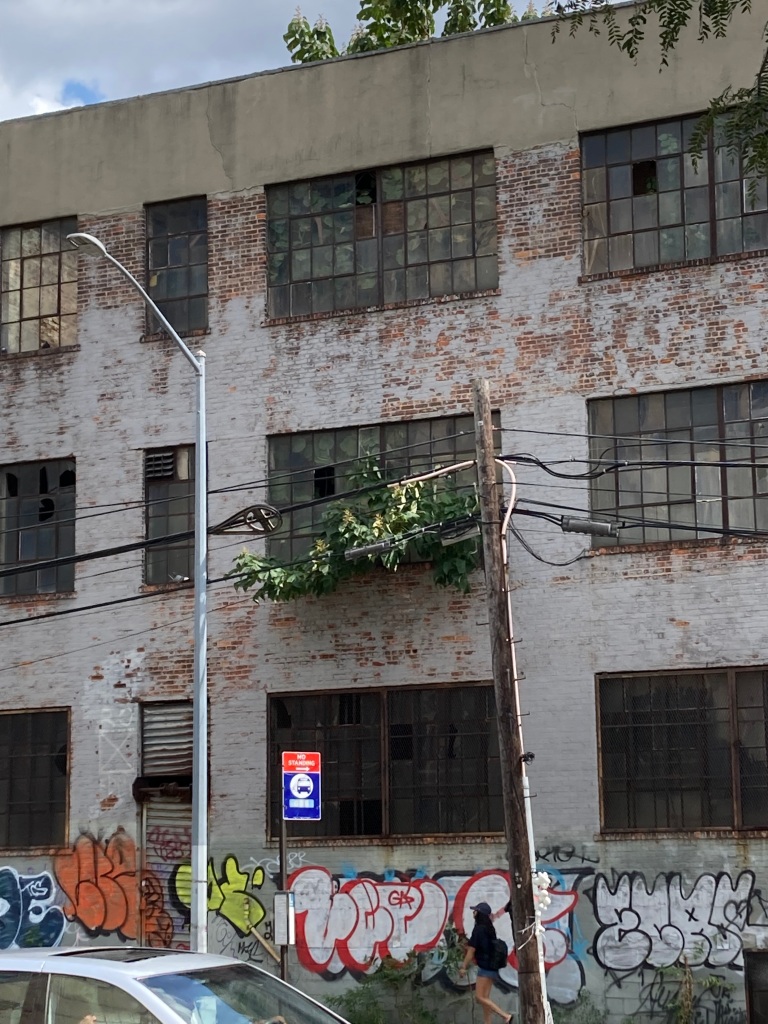
Across from Queensbridge, meanwhile, those giant, graffitied, gray buildings are on their way to becoming Urban Yard, apparently a kind of office complex. When I started this blog in early 2018, I had my eye on those structures. I even tried calling the escalator repair business that I believe was there but no one would talk to me. Recently I noticed a tree growing out of a window. Sometimes I suspected squatters lived inside. On the day I moved here in 2015, got a coffee at Hot Bagels and stored some things at Cube Smart (I had fled a situation in the Bronx and had no apartment for a week or two), I felt like I was moving into an area on the figurative “edge of town.” I still feel that way, but I knew those large gray things looked too much like New York in the ’80s or something, and would be redeveloped soon.

I took this picture in summer 2021 when the Amazon warehouse opened on 21st Street.

In the very first blog post for Corner, I mentioned that the Green Apple supermarket unsurprisingly closed, I guess the final spark of inspiration to start this blog! Last summer, an Amazon warehouse opened at that site.

Since the summer of 2020, I wasn’t sure if I’d continue this blog. From the beginning it seemed like a possibly arrogant and annoying thing to do. But I had a kind of respect for hyper-local blogs, and I wanted to do some writing on my surroundings. While in quarantine in 2020, I started a potential blog post, which turned into a bigger project that I’m still researching. I also filmed the city council primary race for the 26th District. I still need to do a final edit on that. Thanks for coming to this site. As always, I never know if I’ll be back.

The enigma of the ‘lost coast of Queens’

Alma_broadshot_Vernonclose

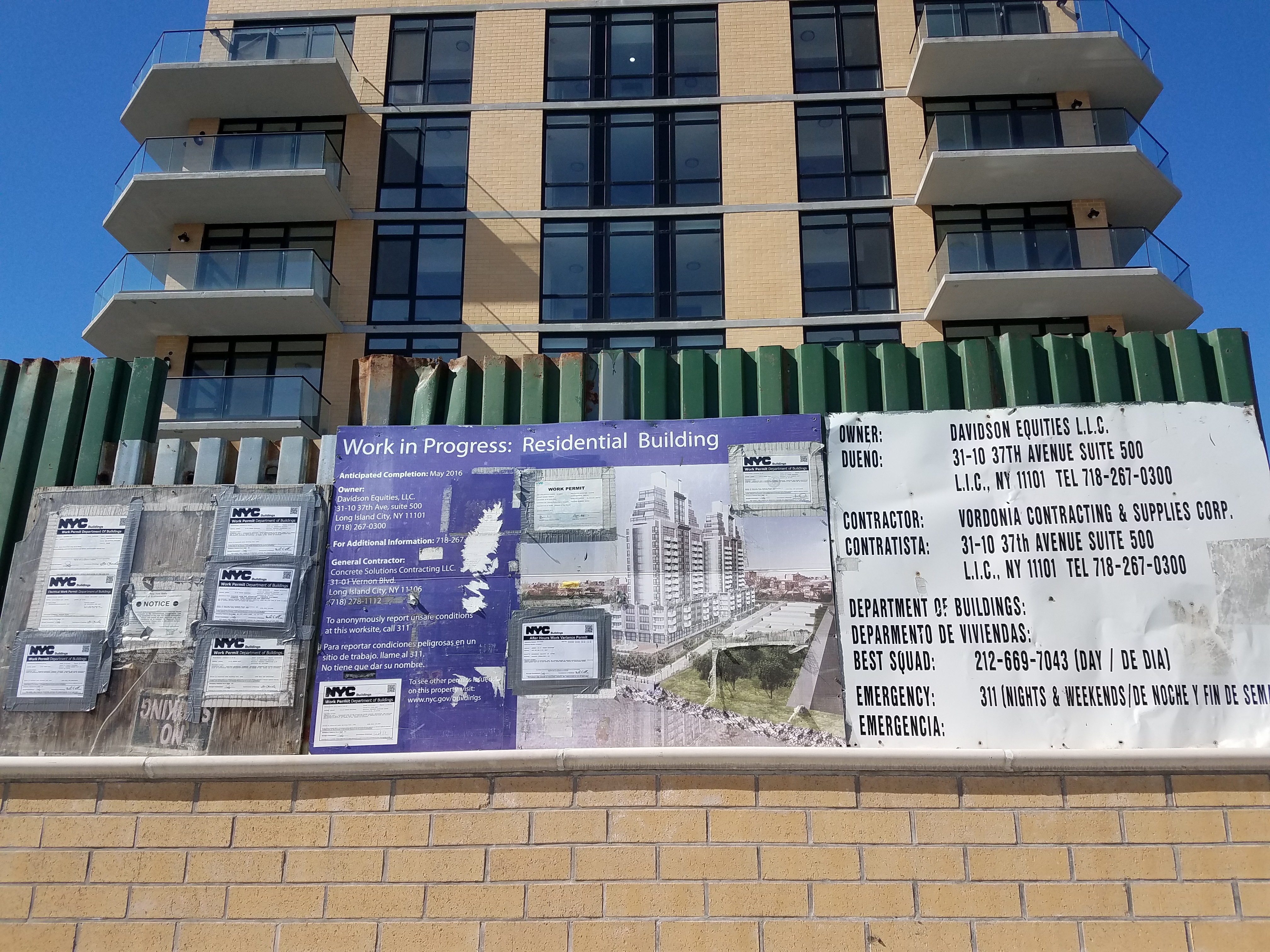
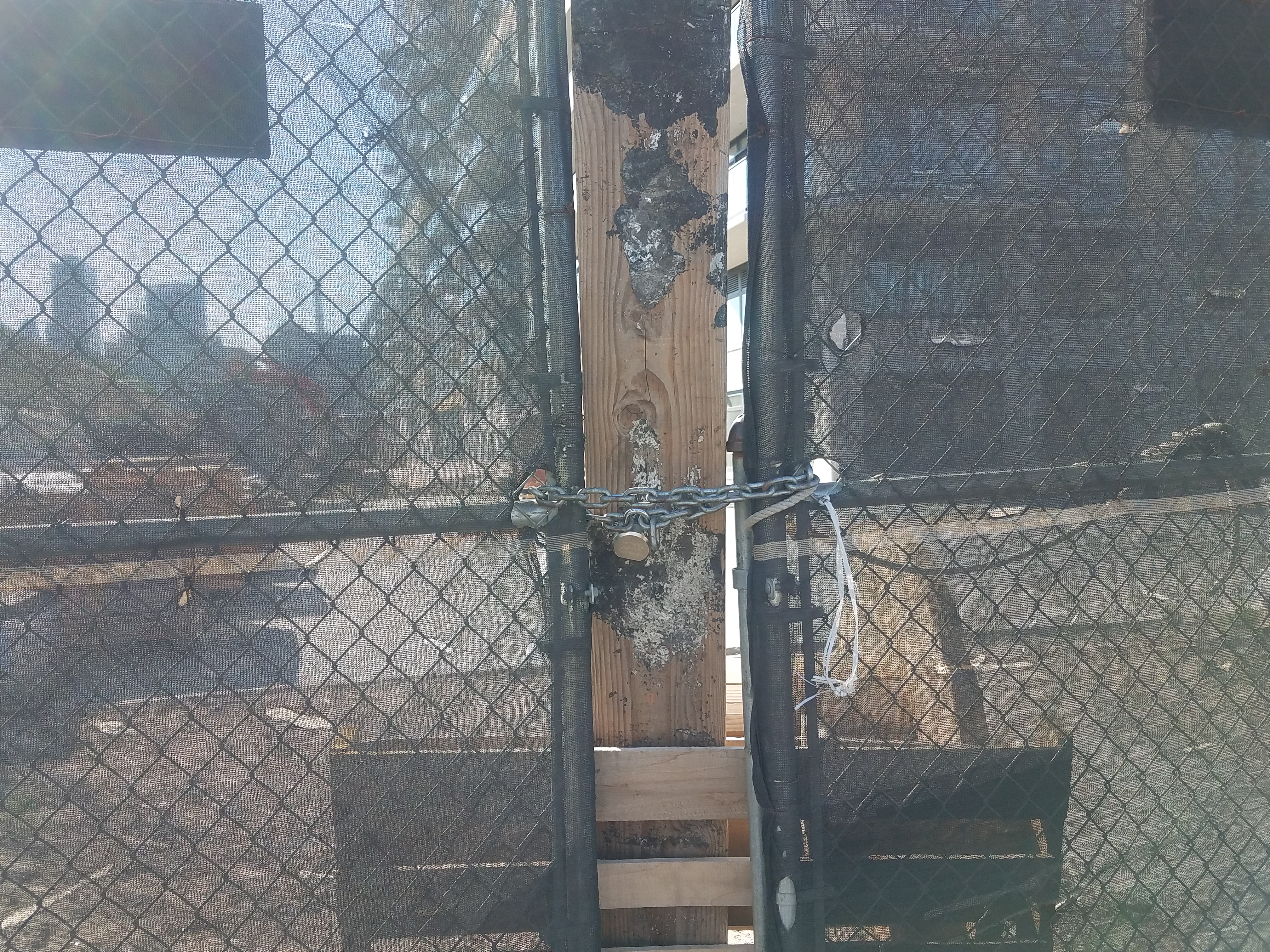
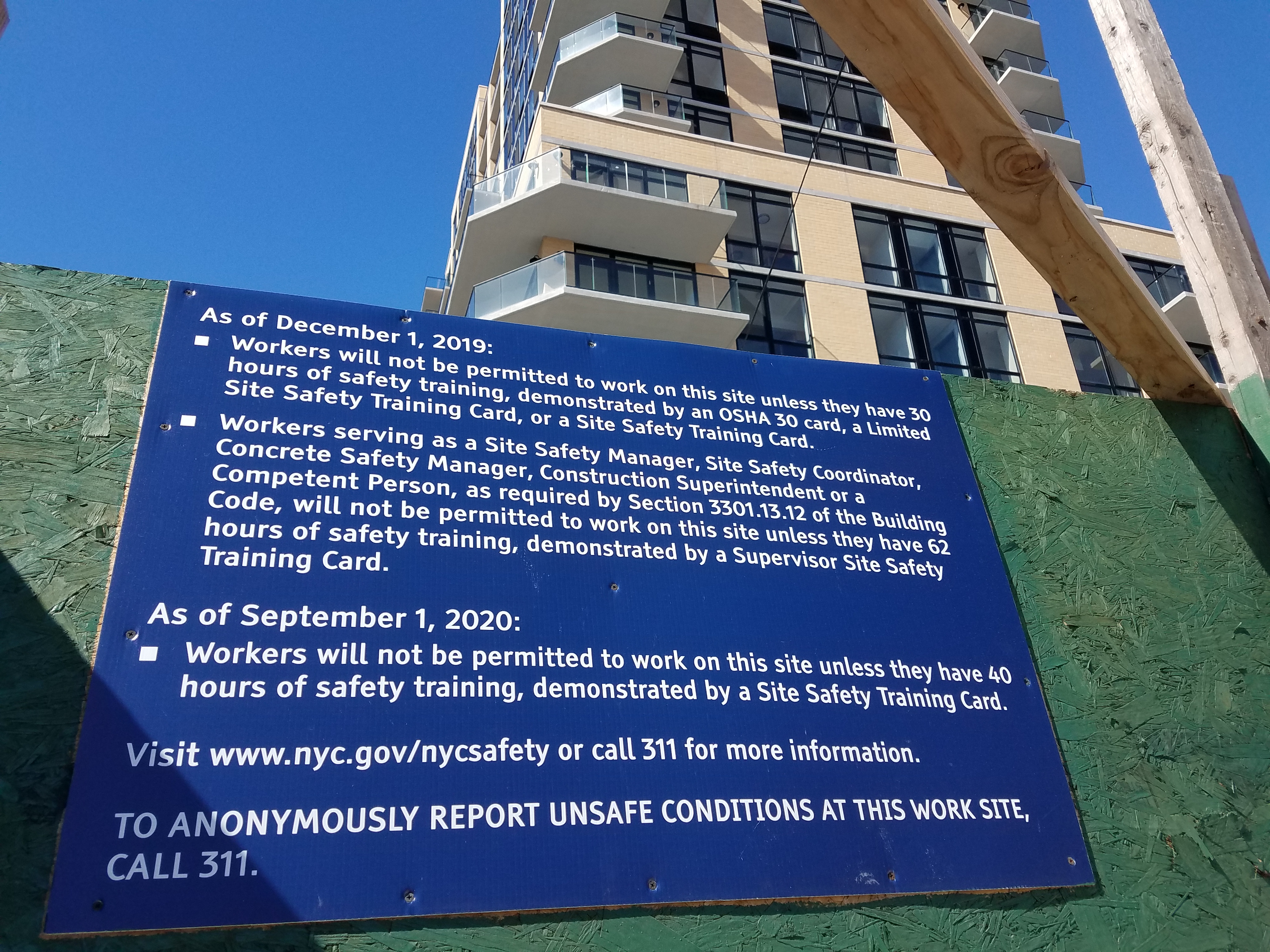
In a 2017 piece titled, “Discovering the Lost Coast of Queens,” the New York Times profiled several of the developing residential building projects along the Astoria-area East River waterfront. The southern-most of those projects, Alma Realty’s 34-46 Vernon Boulevard, was just getting the “finishing touches,” the Times reported then. The double-headed, 17-story, 404-unit development squeezed between a Ravenswood power plant sub-generator and the film and TV warehouse by Rainy Park, was expected to be leasing, the Times had reported, by the fall of 2017. More than two years and a pandemic since that projected date, the yet-to-open set of towers sits behind a wall of deteriorated construction signs and has become a neighborhood enigma.

Alma-Workinprogress

“It is going to open,” an unidentified voice told me, this last July 6, when I called Alma. The building is “still in the process of construction,” the voice said. I asked if there was a delay. “No delay,” the voice said. I was transferred, as usual – I’ve called several times before the Covid-19 pandemic – to a line that went to voicemail.

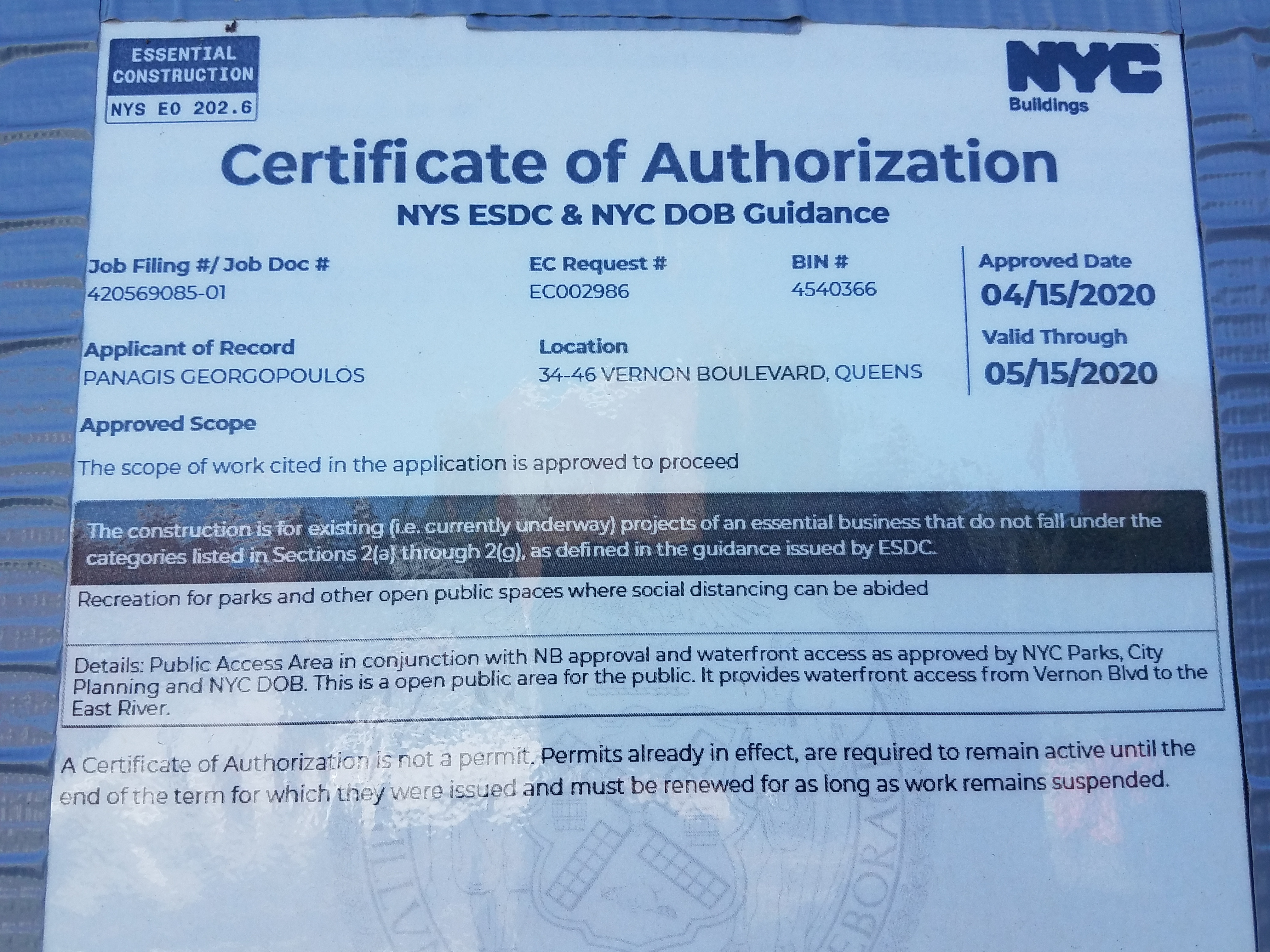
One might use the pandemic as an explanation, but the state didn’t include non-essential construction in its stop-work order until April, and then didn’t, in actuality, fully include non-essential construction until late May. Besides, a document displayed at the site shows Alma was granted an essential business permit to proceed in April. In any case, these last few months don’t count for the five-plus years since construction began.

Alma_chain

Alma_Permit_socialdistancing2020_closer

Five-plus years is almost the same amount of time I’ve lived here, within a few blocks of the site. I’ve watched the building unfold slowly, sometimes having conversations with neighbors or roommates who were confused about the endless construction site/empty building by Rainy Park. One local business owner who’d set up shop after Alma’s construction began, was waiting for the building to open, counting on those hundreds of new potential customers. After the pandemic set in, that person has sold her business, a new cashier told me. Another neighbor is more weary, not looking forward to the influx of high-income tenants. And some people just ask me, because I’m a journalist, if I’ve figured out yet what the deal is with that huge empty building that’s been sitting there more than five years.

To put five-plus years in perspective, 432 Park Avenue, the stick-like super-tower known as the tallest residential building in the Western Hemisphere, just across the East River, took about three years to build. Skyline Tower, the Long Island City residential scraper known as the tallest building in New York outside Manhattan, is expected (New York YIMBY reported on March 30) to be finished by the end of this year, after construction began in late 2017, making work possibly only three years. Vernon Tower, one of the buildings profiled in the Times piece, seems to have been built in about three years. A two-decade analysis in 2018 by real estate site, The Real Deal, found, with the exception of hotels, the median duration of building construction in New York City to be about three years.

The Real Deal also reported, in 2016, that Alma bought the land at 34-46 Vernon Boulevard in 2001. Records show the company filed for excavation and foundation work in 2008. TRD reported in 2010 that the project, then called Alma Towers, had been “beset by construction snags and recession-related issues.” An architect told the outlet that during the economic crisis, rising steel prices necessitated a redesign, pushing the work back to 2012. Work kicked off in the fall of 2014, YIMBY had reported, bringing the site up to 13 or 14 stories by June 2015. The signage at that time projected a completion date of spring 2016.

From what I can tell, the usual real estate outlets stopped reporting on the project except for the Times’ real estate section with its “Lost Coast” piece, which also used the phrase “gold coast.” One of the developments mentioned, Alma’s other, more high-profile project – a five-building, 1,700 unit megaproject – Astoria Cove, was slated for a site by the Astoria Houses on the northern edge of the Halletts Point peninsula, next to the Hallets Point megaproject. After facing pressure from affordable housing advocates, organized labor and then-Borough President Melinda Katz, the Astoria Cove zoning proposal passed the City Council in late 2014, becoming the first development to fall under Mayor de Blasio’s Mandatory Inclusionary Zoning program, with 27 percent of the units below market rate. Alma never broke ground on the project, which was, in 2016, attributed to the expiration of state tax abatement program 421-a. The company put the site on the market, temporarily. In a 2019 post-mortem of sorts, Politico New York later said the project “didn’t actually have the correct breakdown of low-income units to qualify for the new version of [the 421-a] abatement.” The Politico piece ultimately portrays Alma as possibly an inept, minor developer in over its head.

The print version of the Times’ piece was titled, “The Lost Coast of Queens,” which suggests the Astoria-area waterfront had been known in the past. Maybe the point was developers had forgotten about it since the Shore Towers were built in 1990 or since East River Tower was built in 2007. The online article included the word, “Discovering,” suggesting, perhaps, developers had been unaware that desirable, as in convenient or scenic, waterfront existed north the Gantry Plaza State Park. The piece, apparently contradicting those notions, describes Alma as “a family-run firm that has invested in the area for decades.” That’s because Alma is part of the area. The company, which has properties all around the Tri-state area and more than a dozen branch offices, has its headquarters about 15 blocks away, or a 20 minute walk, from 34-46 Vernon Boulevard, at 31-10 37th Avenue in the Dutch Kills section of Long Island City. Alma’s founder, Efstathios Valiotis, came to the U.S. from Greece, a TRD profile says, in 1972. LIC-based Greek-American newspaper the National Herald toured Alma’s headquarters in 2017, describing Alma as “one, if not the only one, of the few expatriate companies from the concierge up to the supervisors in complex construction who speak Greek.”

The National Herald, which appears to have mixed up the Citigroup Building with Citicorp Center, misdating the arrival of the former by at least 10 years, and may have exaggerated Alma’s stock in the emerging waterfront (Astoria Cove and 34-46 Vernon Boulevard together would have surpassed Halletts Point by only about 100 units), was given a tour of 34-46 Vernon Boulevard. The Herald reported, back then in 2017, that the “apartments are functional,” set with washer-dryers and balconies, though I’m not sure the balconies were finished. The piece, which doesn’t get into delays or politics, is a warm portrait of Valiotis and his daughter, the company CEO Sophia Valiotis, involving a photo of them in an office, behind them a stack of cases of Crystal Geyser sparkling water. The short TRD profile of Efstathios (or Steve) Valiotis includes an alleged 1990s European bank-corruption scheme. In 2015, Politico New York reported, tenants rights group Stabilizing NYC included Alma on its offender list. The group found seven Alma buildings in Brooklyn and Manhattan with reports of tenant harassment, disrepair and vermin. Con Edison was suing Alma for stolen gas. In 2016, then-Public Advocate Leticia James listed Valiotis as the number three worst landlord in New York City for racking up 1,141 total violations. Valiotis is not on Public Advocate Jumaane Williams’ current list. As of this post, Department of Buildings records show the project at 34-46 Vernon Boulevard has racked up 97 violations.

Alma-safetytraining

25 to Life For 36th Ave Murder

Two years ago today, a man was killed on 36th Avenue near 14th Street. 

Today, Judge Kenneth Holder sentenced Javyn McNish, now 21, from the Ravenswood Houses, to 25 years to life, for slaying Jerell Lewis, 20, from Queensbridge, at 4:10PM on December 2, 2017. 

On that day, McNish’s friend told him that he’d been in a fight with Lewis, accounts found. McNish then, is said to have chased Lewis into the street near the Ravenswood Houses. He then shot at Lewis three times, say reports, hitting him in the chest, torso and the arm or hand. A bullet to the spinal chord is said to have paralyzed Lewis. McNish is said to have then pistol-whipped Lewis, knocking out two of his teeth. Lewis died later at Mount Sinai Hospital. 

McNish, seen on surveillance video, was later found in an apartment with a 9mm semi-automatic pistol. He was charged two days after the death with murder and criminal possession of a weapon.  Continue reading “25 to Life For 36th Ave Murder”

Ravenswood-Dutch Kills top Queens in falling real estate prices

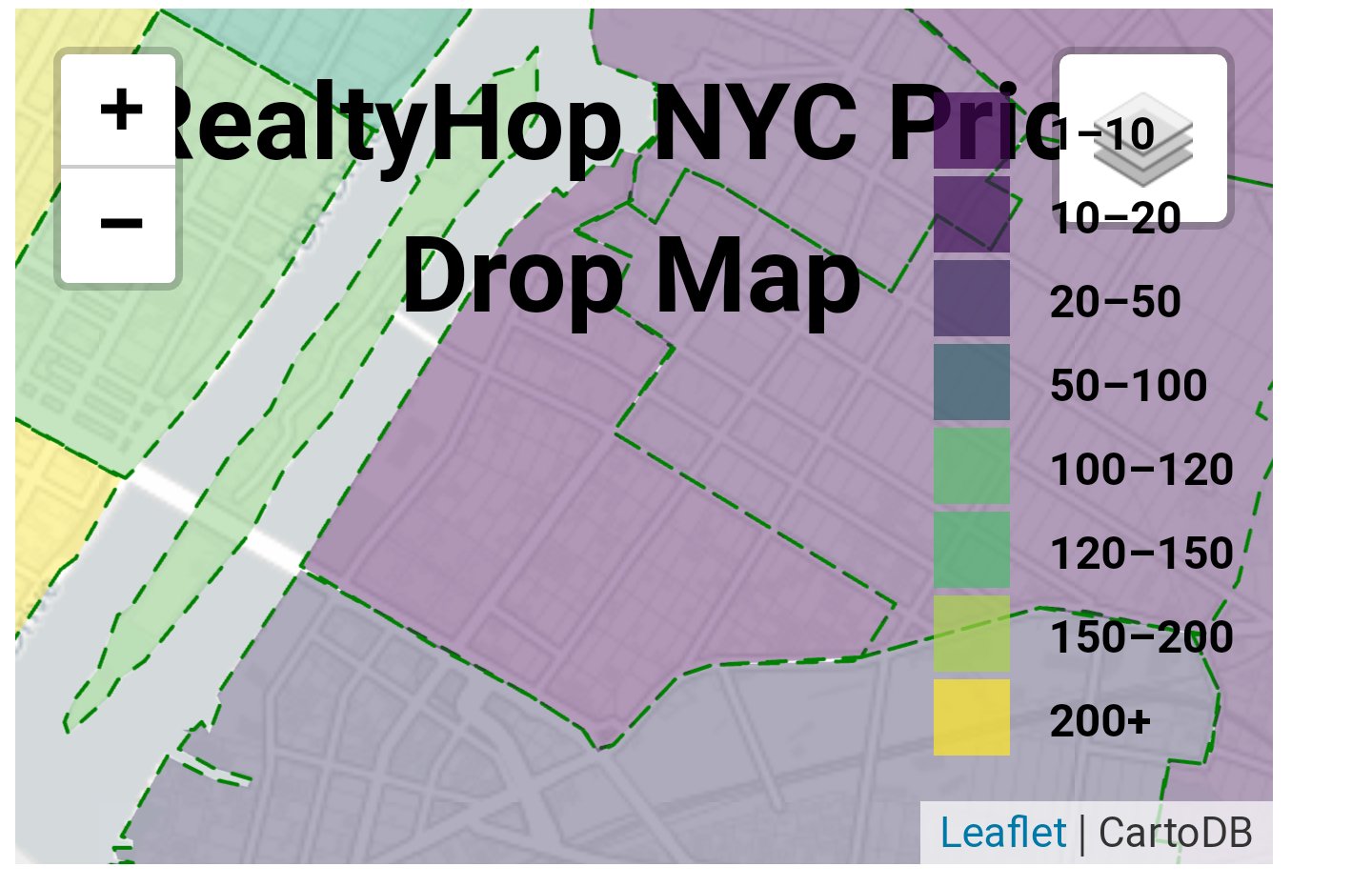
A RealtyHop analysis found that the Ravenswood-Dutch Kills area led Queens in falling median percentage real estate prices in June.

The area, identified as “Queensbridge-Ravenswood-Long Island City,” – the map shows Ravenswood, QB and Dutch Kills below 36th Ave over to Northern Boulevard – saw a median percentage price drop of 10.6% (-$133,475). What, no one wants to live here anymore?

Just behind us is East Elmhurst, followed by the Hammels-Arverne-Edgemere part of the Rockaways, followed by Jamaica, according to a closer read by Queens Courier.

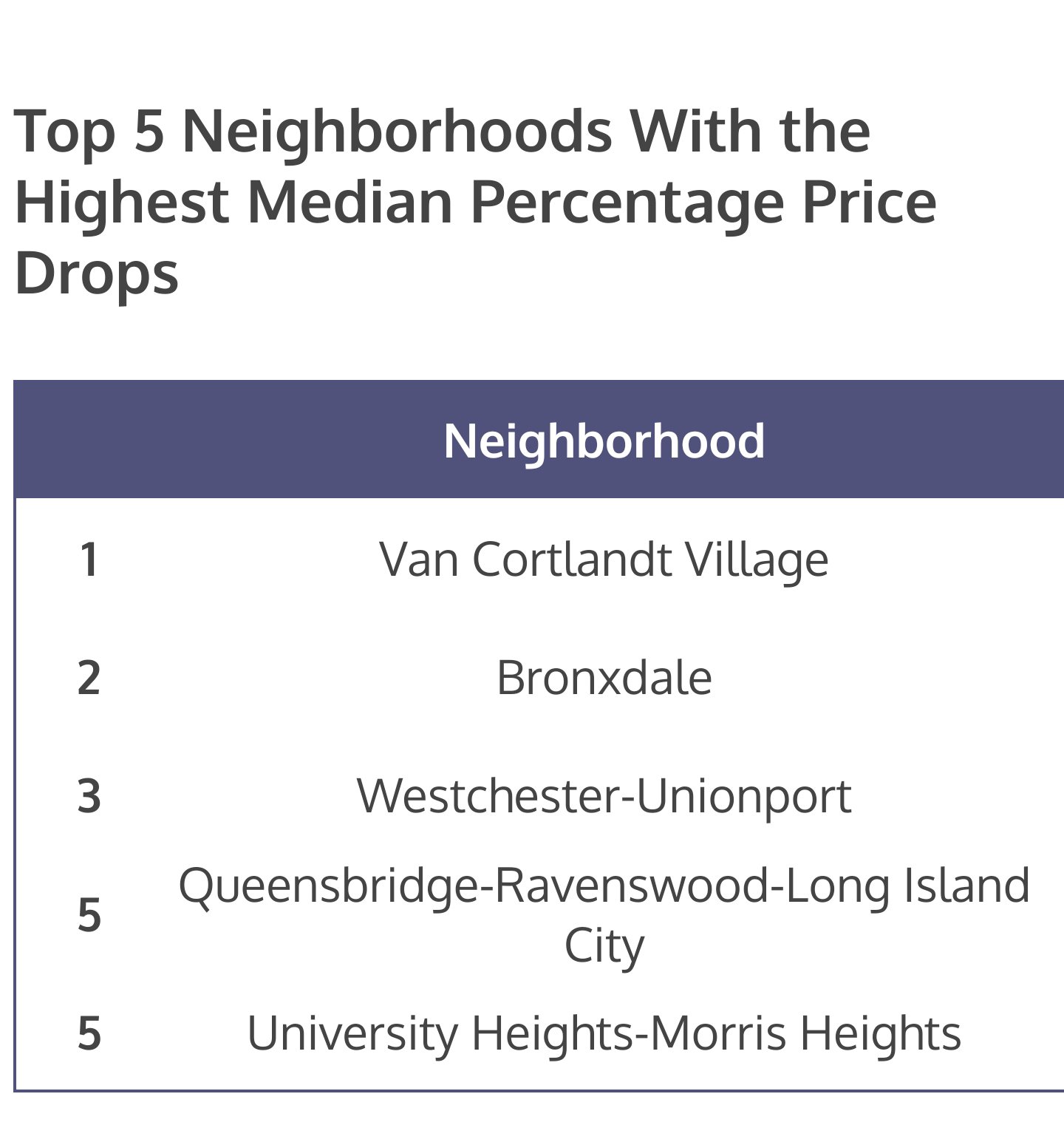
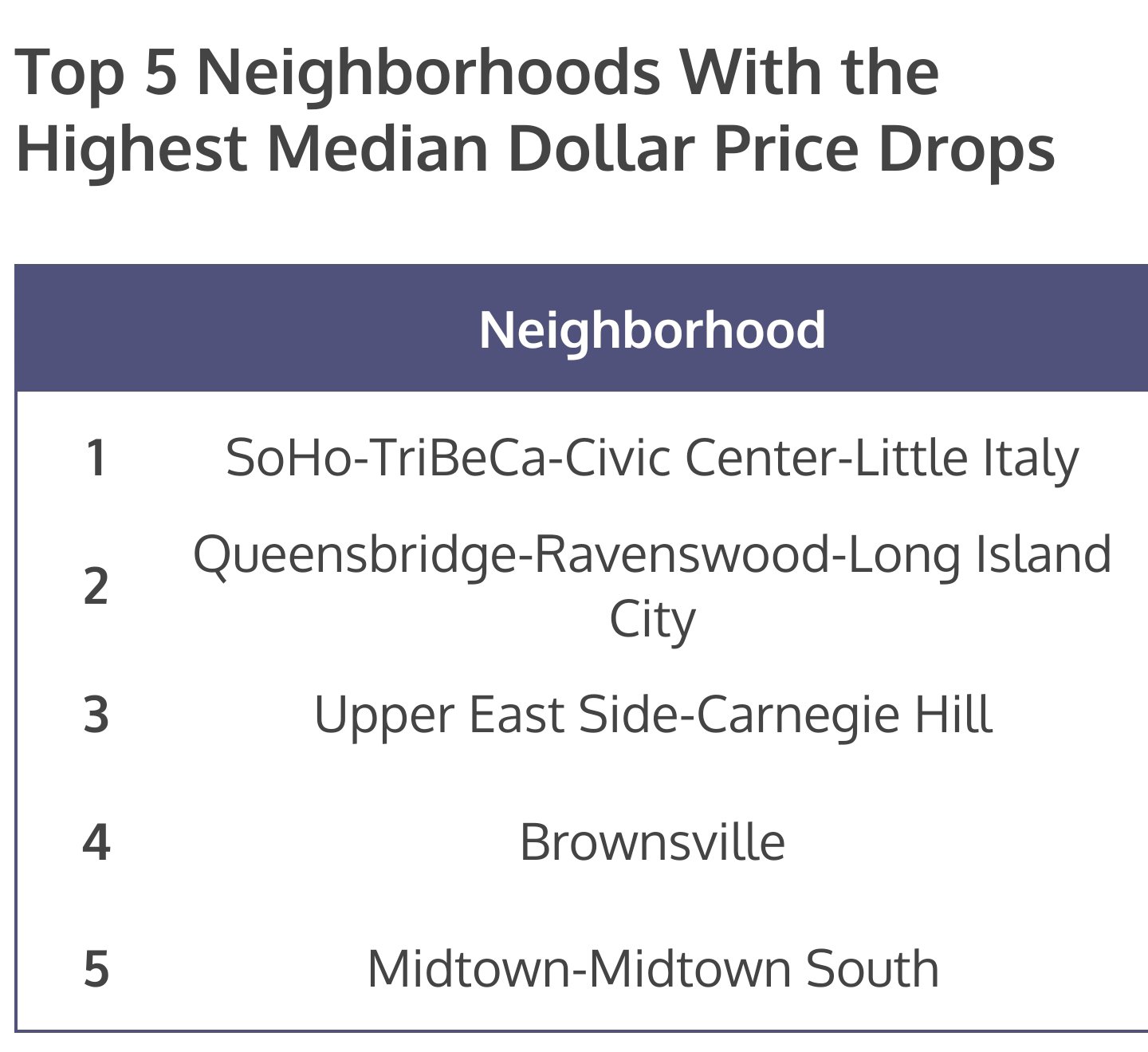
We came in four citywide for top five highest median percentage price drops, sharing a category with four Bronx neighborhoods, and made the top five list for neighborhoods with highest median dollar price drops, at number two just behind SoHo-Tribeca-Civic Center-Little Italy. Yea, check us out.

H/T Queens Courier

Sunday morning murder outside Ravenswood Houses

Jelan Moreira, 29, Ravenswood Houses resident and father of two young kids was shot to death around 5:20 a.m. Sunday on 21st Street by 35th Avenue, multiple news outlets report. 

“People are going to say, ‘He was a great guy.’ But he really was a great guy,” a neighbor told the New York Daily News. “He didn’t have a problem with anybody. He always had a smile on his face.”

A 17 year-old suspect was arrested. The New York Post reports one ran off. The News reports a second suspect was being questioned. 

35th Ave and 12th Street building could look like this

35thAverend1

A rendering of the obscure Ravi Management’s planned eight story building for the southwest corner of 12th Street and 35th Avenue shows a light-toned jumbo cube. Maybe I couldn’t see the rendering if it was shown at the hearing over the item at CB1’s land-use committee’s rezoning hearing last month – but it was shown on a slide at a full Community Board 1 meeting last night, where the board approved of the rezoning plan with certain stipulations.

Continue reading “35th Ave and 12th Street building could look like this”

Permits filed for 14th hotel site in Ravenswood IBZ

IBZ_hotel_map_ravenswood_permit1
Above, 13 of 14 sites I’ve counted in or near the edge of the Ravenswood IBZ, a dramatic cluster for an otherwise low-scale industrial zone. 

New York YIMBY reports permits were filed for a 15 story hotel in the northwest section of the Ravenswood Industrial Business Zone. The ten block zone stretching along the waterfront from Queensbridge to 37th Avenue west of 21st Street is literally overrun with hotels counter to zoning intended to preserve manufacturing – as Corner has detailed. Most of the hotel sites (several haven’t been finished yet) are concentrated towards the southeast part of the zone along 40th Avenue. This new site at 37-10 10th Street is the third I’m aware of along 37th Ave and would be the most northwest of the cluster, near P.S. 76 William Hallett. The permit was filed by developer Dun Zhang with architect Gene Kaufman, which tells us this won’t be another Hotel Nirvana. On April 23, a week less than 60 days ago, the Department of City Planning launched a 60 day public review process for a proposal that would only allow hotels in the IBZs with a special permit.

A lower-west Astorian tries to get to Manhattan at night

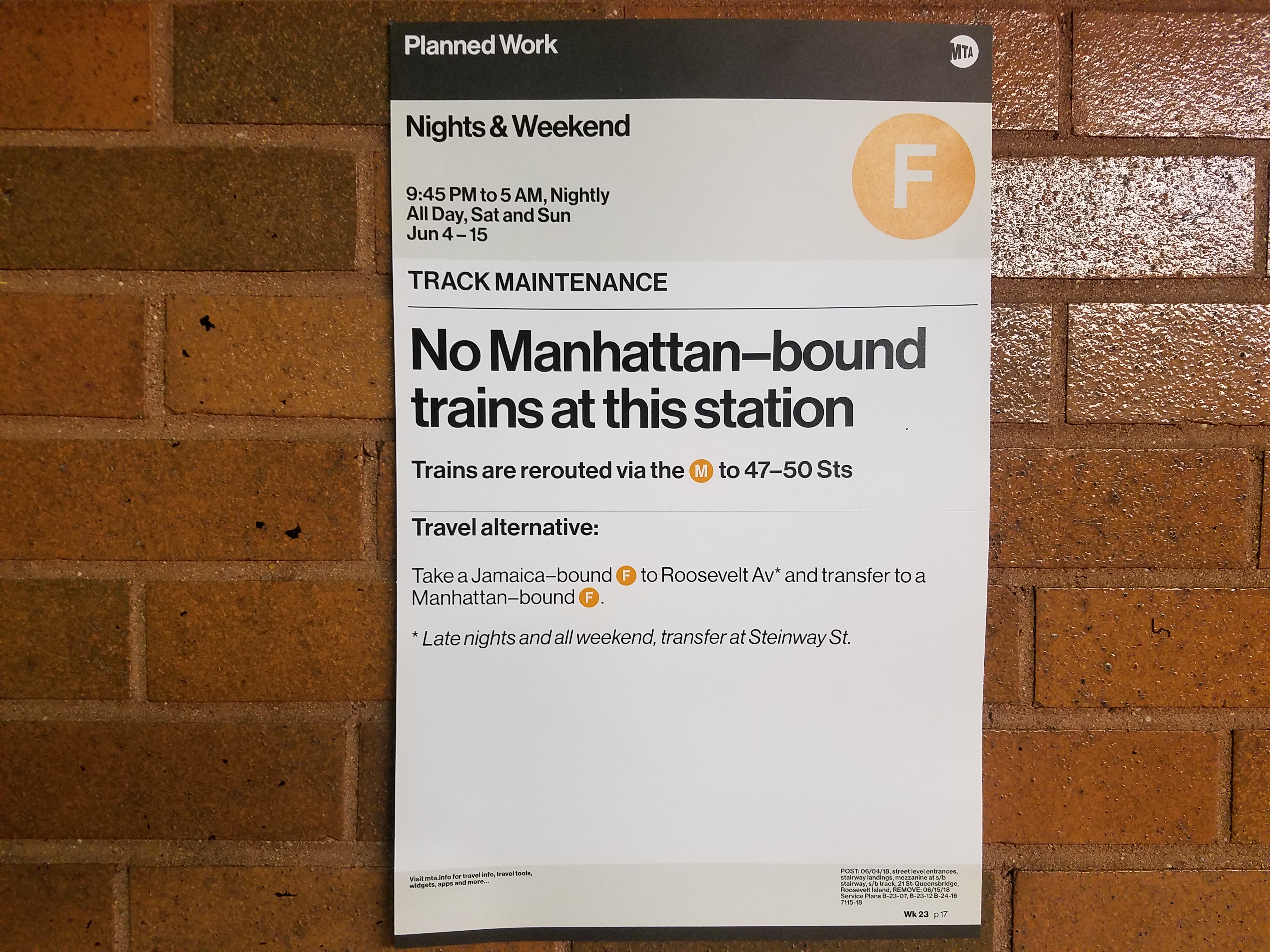
This morning I noticed an MTA employee putting up a sign at the Queensbridge-21st Street station warning no F trains are departing to Manhattan from there at night from June 4 (a week ago) until June 16. Obviously I haven’t tried to go to Manhattan from the neighborhood this last week, but for whoever is trying to go that way from the Ravenswood area, let’s say around deep 36th Avenue, there is no N/W or F train option at night, unless that person takes the F backwards to Roosevelt Avenue first. Or walks or bikes or buses to 39th Ave or Broadway or Queens Plaza. So for any of these people who work at night or for any other reason, I feel for you. The N/W 36th Street Station is said to be set to open at the end of June.

Rezonings for new apartment buildings on 21st Street, 35th Ave get heard out

Project_Sight_Plan_slideupclose
Jaclyn Calcagno Scarinci, attorney representing Ravi Management details the Ravenswood corner rezoning plan to CB1.

At a public hearing for a couple of rezoning proposals for potential apartment buildings in lower-west Astoria and Long Island City Thursday, the question seemed to become how new, not-so small developments with mostly market-rate housing will lend to the future of the neighborhood.

Map_twobuildings_pink
Modified Google Maps screenshot-map of the proposed re-zonings.

Community Board 1 held the hearing at the NYCHA Ravenswood Houses, between the two sites of interest. One proposal is for rezoning 11-14 35th Avenue at the corner of 12th Street from commercial to mixed-use so that United Crane and Rigging would be replaced by an eight-story building with 74 residential units and retail at the base. (For some perspective, the Ravenswood Houses across 12th Street are six stories tall.) In the other, Variety Boys and Girls Club is proposing to replace its existing building at 21-12 30th Road along 21st Street with a larger club space attached to a 14 story apartment building. The apartment building, owned by a yet-to-be-identified developer, would pay for the club’s expansion. Continue reading “Rezonings for new apartment buildings on 21st Street, 35th Ave get heard out”